
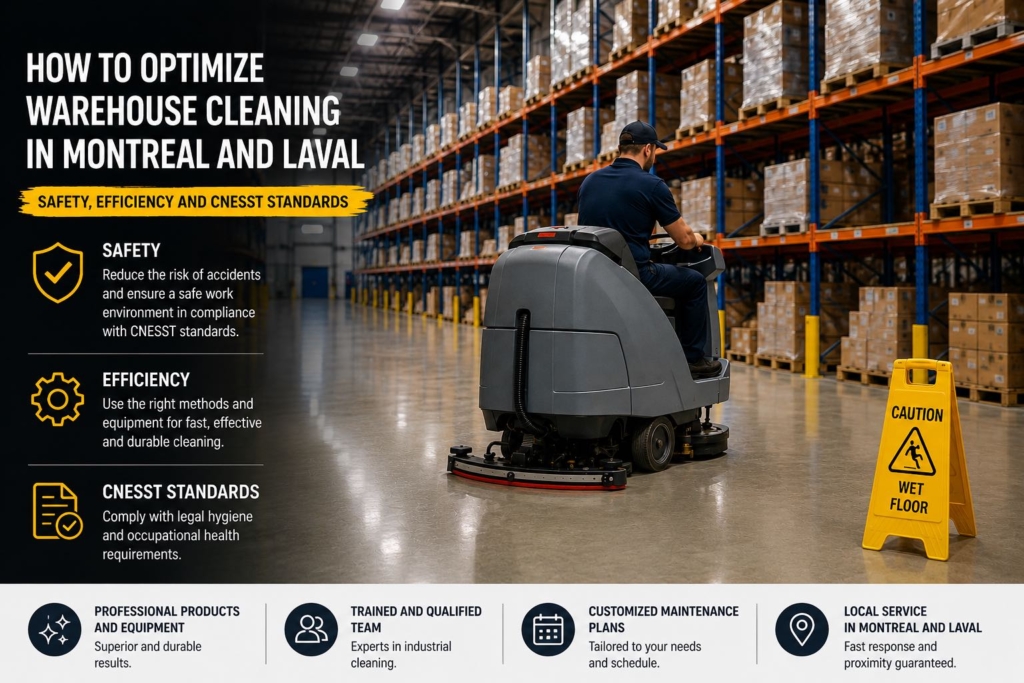
When managing a warehouse, factory, or distribution center in the Greater Montreal Area or Laval, the number one priority always remains the same: keeping the supply chain moving. Pallets come in, forklifts zip around, and orders are prepped. In this daily whirlwind, cleanliness, safety, and the industrial cleaning of your premises can easily slip to the back burner.
However, in an industrial environment, a slippery floor or dust accumulation at heights isn’t just a cosmetic issue. It directly impacts performance, profitability, and, above all, legal compliance.
In Quebec, the CNESST (Commission des normes, de l’équité, de la santé et de la sécurité du travail) strictly regulates workplace health and safety. According to Article 51 of the Act respecting occupational health and safety (AOHS), employers have a strict obligation to maintain their premises in a state of cleanliness that ensures the safety of workers.
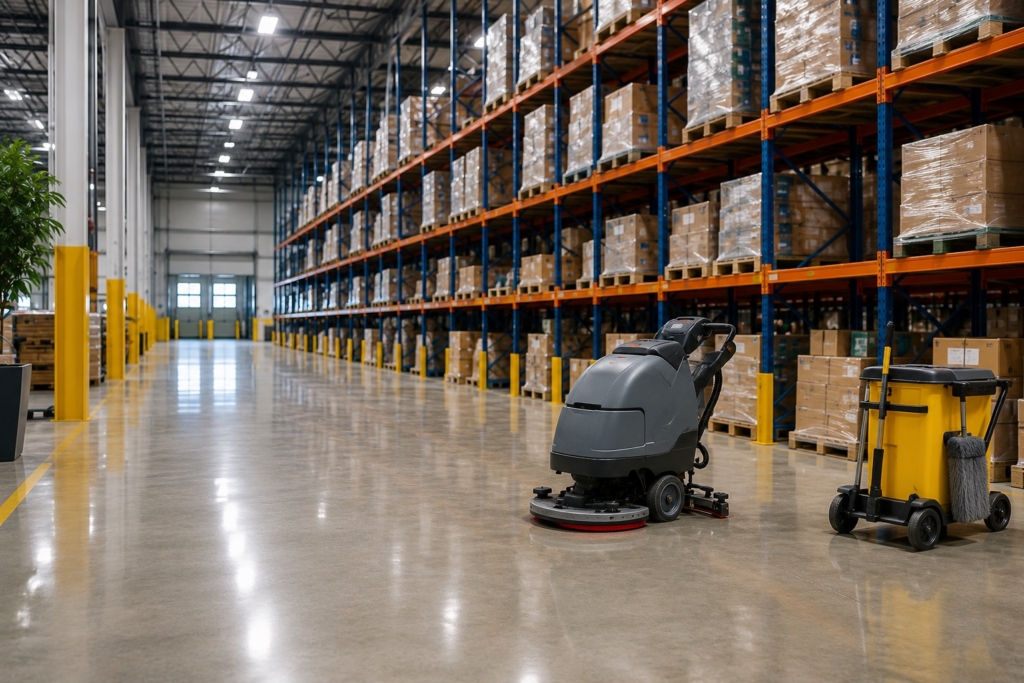
Here is a practical guide to understanding the concrete risks of poor maintenance and discovering how to optimize your logistics space.
1. Floor Safety: Your First Line of Defense Against Accidents
Slips, trips, and falls are among the most common causes of workplace accidents in Quebec warehouses. A floor contaminated by industrial fluids quickly becomes a critical hazard zone.
-
The Invisible Danger of Fluids: Hydraulic oil leaks, grease, or coolant from forklifts create a thin, invisible film on concrete or epoxy. Beyond the risk to pedestrian employees, this significantly reduces forklift tire traction, increasing braking distances and the risk of collisions with racking systems.
-
The Solution: A simple sweep is never enough. Keeping floors safe requires regular mechanical scrubbing using ride-on industrial scrubbers, combined with certified industrial degreasers. This heavy-duty equipment extracts embedded oils from porous concrete in a single pass while leaving the floor perfectly dry and immediately safe for traffic.
2. High-Dusting: Eliminating Fire Hazards and Protecting Respiratory Health
The industrial cleaning of a warehouse must also address high structures. The upper sections of a facility accumulate immense amounts of dust. Support beams, ventilation ducts, light fixtures, and the tops of pallet racks (which often exceed 20 or 30 feet) become massive sediment reservoirs.
-
The Risk of Fire and Flash Deflagrations: Insurance companies are becoming increasingly strict about this. Certain industrial dust accumulations are highly combustible. A minor electrical spark near the ceiling can trigger a major fire. Furthermore, heavy dust buildup reduces the efficiency of your sprinkler systems and dims lighting, causing eye strain for forklift operators.
-
Air Quality Regulations: The Regulation respecting occupational health and safety (ROHS) imposes strict limits on air quality. When forklifts operate, vibrations cause this fine dust to settle back down, where it is inhaled by your teams, increasing absenteeism due to respiratory issues.
-
The Solution: A high-dusting intervention carried out by qualified technicians using scissor lifts and industrial vacuums equipped with HEPA filters. This specialized work should ideally be scheduled on a semi-annual or annual basis.
3. Critical Areas: Loading Docks and Common Spaces
An effective industrial cleaning and commercial janitorial program must divide your warehouse into distinct risk zones:
-
Loading Docks: This is the transition zone to the outside world. Moisture, wooden pallet debris, shrink wrap scraps, and truck exhaust pollution accumulate here daily. A thorough weekly cleaning of these zones is essential to stop outdoor dirt from spreading throughout the entire facility.
-
Restrooms and Breakrooms: CNESST inspectors pay close attention to employee hygiene facilities. Regulations dictate that breakrooms and restrooms must be rigorously cleaned during every single shift. A clean break space not only reinforces compliance but also demonstrates respect for your workforce, boosting overall workplace morale.
4. Industrial Cleaning and Business Continuity: Zero Production Downtime
The biggest challenge for a logistics manager is coordinating maintenance without paralyzing shipments. Stopping a production line or blocking a picking zone during the day is incredibly costly.
This is why scheduling flexibility is a major factor when choosing your cleaning provider. Major interventions—like deep-degreasing traffic lanes or washing high structures—are best executed at night, over weekends, or during shift changes. Professional teams are trained to work in phases, cordoning off active cleaning zones so your forklifts can continue to move safely throughout the rest of the building.
Conclusion: A Smart and Profitable Business Strategy
Keeping a warehouse clean in Montreal or Laval isn’t an unnecessary expense; it’s an intelligent business strategy. By outsourcing your maintenance to an expert team, you protect your infrastructure, avoid costly CNESST correction notices, and provide a healthy environment for your staff.
Want to evaluate the condition of your floors or schedule a high-dusting for your structures? Contact our experts at Go Pro Cleaning today for an on-site analysis and a personalized quote for your business.